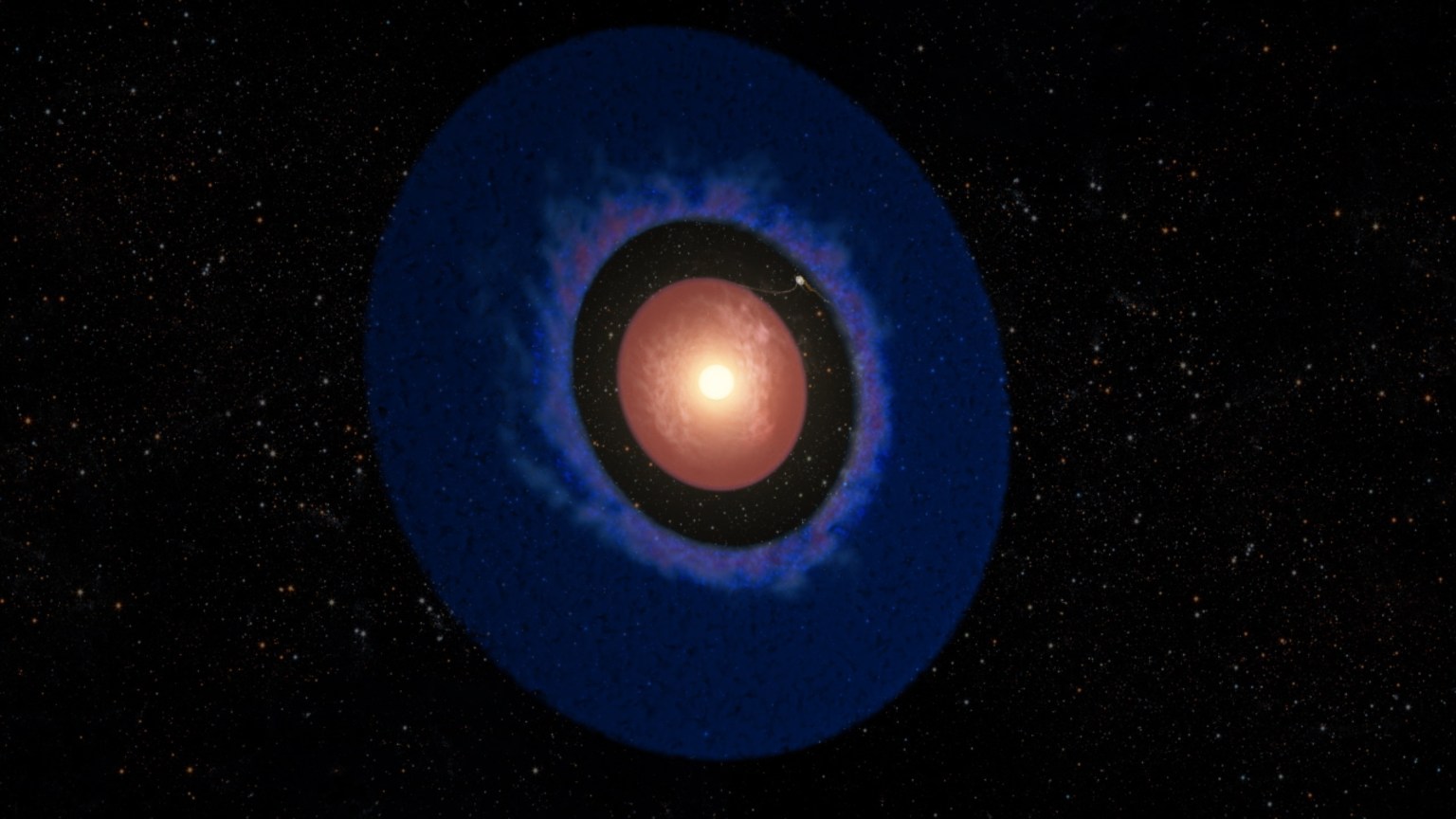
A team led by Andrea Bernardi, a PhD student at Universidad Diego Portales and a member of the Millennium Nucleus YEMS, has confirmed the protoplanet Elias 2-24 b: a Jupiter-mass world less than one million years old, still embedded in the gas and dust disk where it is forming. YEMS is funded by Chile's Agencia Nacional de Investigación y Desarrollo (ANID) through the Millennium Science Initiative. The result, published in The Astrophysical Journal Letters and highlighted in a NASA Science press release, adds one of the clearest examples yet of a planet occupying and shaping a gap in a protoplanetary disk.
Elias 2-24 lies about 450 light-years from Earth. The system had attracted attention for years because ALMA observations revealed a prominent gap in its dusty disk, while later observations with ESO's Very Large Telescope found a faint point source inside that gap. The new study combines those earlier clues with archival observations from the W. M. Keck Observatory to show that the source moves as a bound planet rather than an imaging artifact or a background star.
Artist's concept of Elias 2-24 b, still growing inside the disk of gas and dust surrounding its young host star. Credit: W. M. Keck Observatory/Adam Makarenko. Image via NASA Science.
A planet caught in the act of forming
Most confirmed exoplanets are mature worlds, often billions of years old. Elias 2-24 b is different: the host system is younger than one million years and the planet appears to be actively accreting material from its surroundings. NASA notes that the previous youngest directly studied planets are more than five million years old, making Elias 2-24 b an especially demanding test for theories of how quickly giant planets can assemble.
The planet lies roughly 55 times farther from its star than Earth is from the Sun. Standard models have difficulty producing a Jupiter-mass planet so quickly at such a large separation, making the system an important laboratory for improving models of giant-planet formation and early evolution.
“The planets should be found within the gaps, since they are carving them,” Bernardi explained in the NASA release. “And that's exactly where we found Elias 2-24 b.”
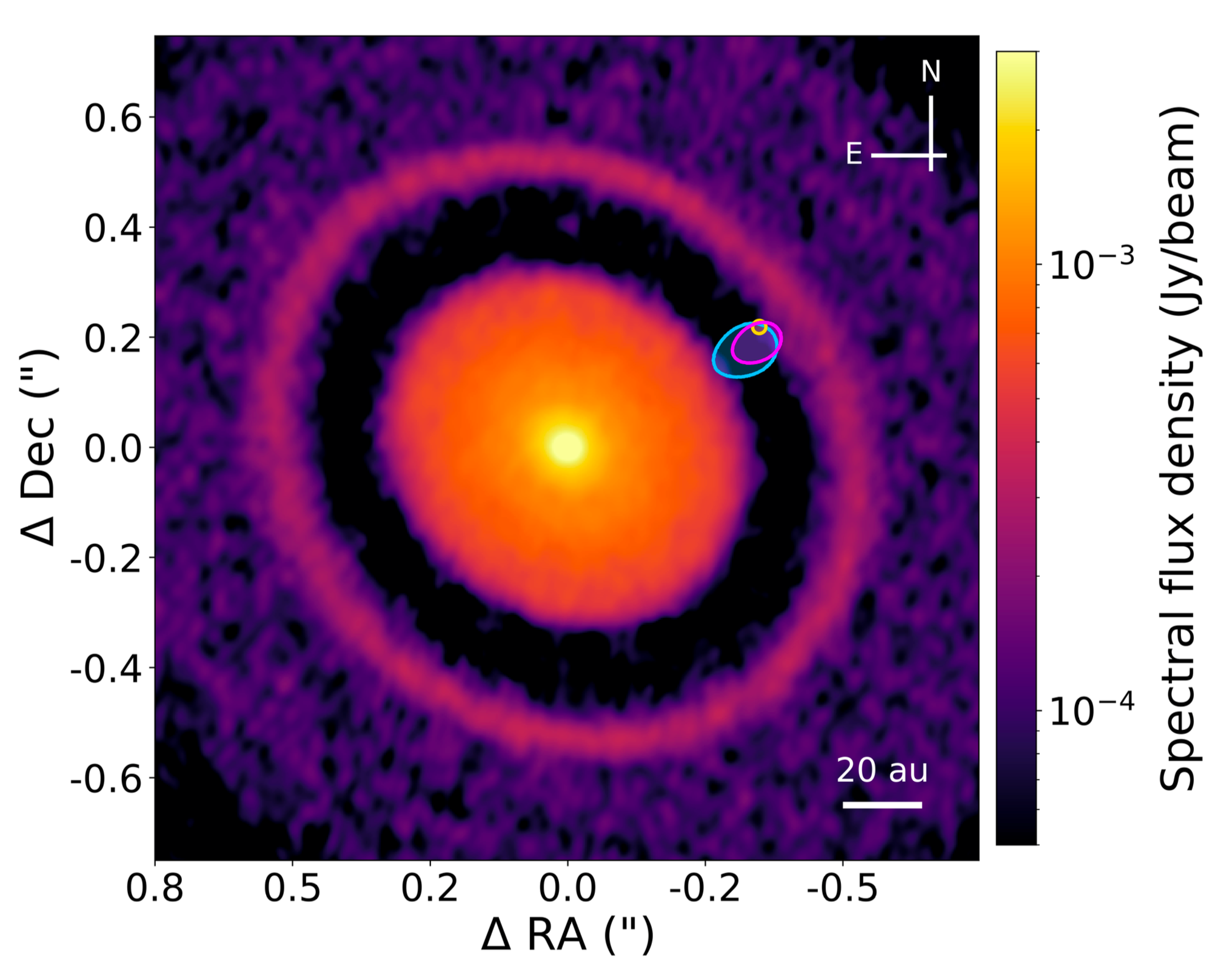
ALMA 1.3 mm continuum observation from the DSHARP survey. The magenta, blue, and gold regions mark the area enclosing the companion position from this work and previous literature claims. Elias 2-24 b lies in the disk gap and is associated with the accumulation of dust at the inner edge of the outer disk. Credit: Bernardi et al. (2026).
Connecting ALMA, the VLT and Keck
The confirmation depended on bringing together observations from several facilities. ALMA first mapped the disk structure; the VLT revealed a faint source inside the gap; and Bernardi's team returned to the NASA-funded Keck Observatory Archive, identifying the same source in observations obtained in 2018 and 2020. Following its position through time allowed the team to distinguish orbital motion from a static background object or an instrumental artifact.
“We usually hear about telescopes working separately, but this confirmation was possible only by using multiple telescopes together,” Bernardi said in the NASA release. The result also highlights the long-term scientific value of astronomical archives: data taken years earlier can become decisive when combined with new methods and additional observations.
A new member of a very small sample
For YEMS, the discovery directly addresses one of the centre's central goals: observing planetary systems at the earliest stages of their evolution and connecting structures in young disks with the planets that create them.
“It is exciting to add another system to the very small sample of planets we can study while they are still forming,” says Sebastián Pérez, YEMS researcher and professor at Universidad de Santiago de Chile. “These are the systems that let us confront planet-formation models with the process itself, rather than only with its final products.”
Andrea Bernardi is a PhD student at Universidad Diego Portales and a member of the Millennium Nucleus on Young Exoplanets and their Moons (YEMS). YEMS is funded by Chile's Agencia Nacional de Investigación y Desarrollo (ANID) through the Iniciativa Científica Milenio. The team also includes YEMS researchers Lucas Cieza and Alice Zurlo, who have been studying this and other young planetary systems from Chile.
The discovery gives astronomers a rare opportunity to follow a giant planet while it is still assembling. Future spectroscopy and continued astrometric monitoring should help constrain its mass, atmosphere and accretion state, providing a benchmark for models of young giant planets.
Source: NASA Science, “Newfound ‘Baby’ Planet Smashes Record for Youngest Known World”.