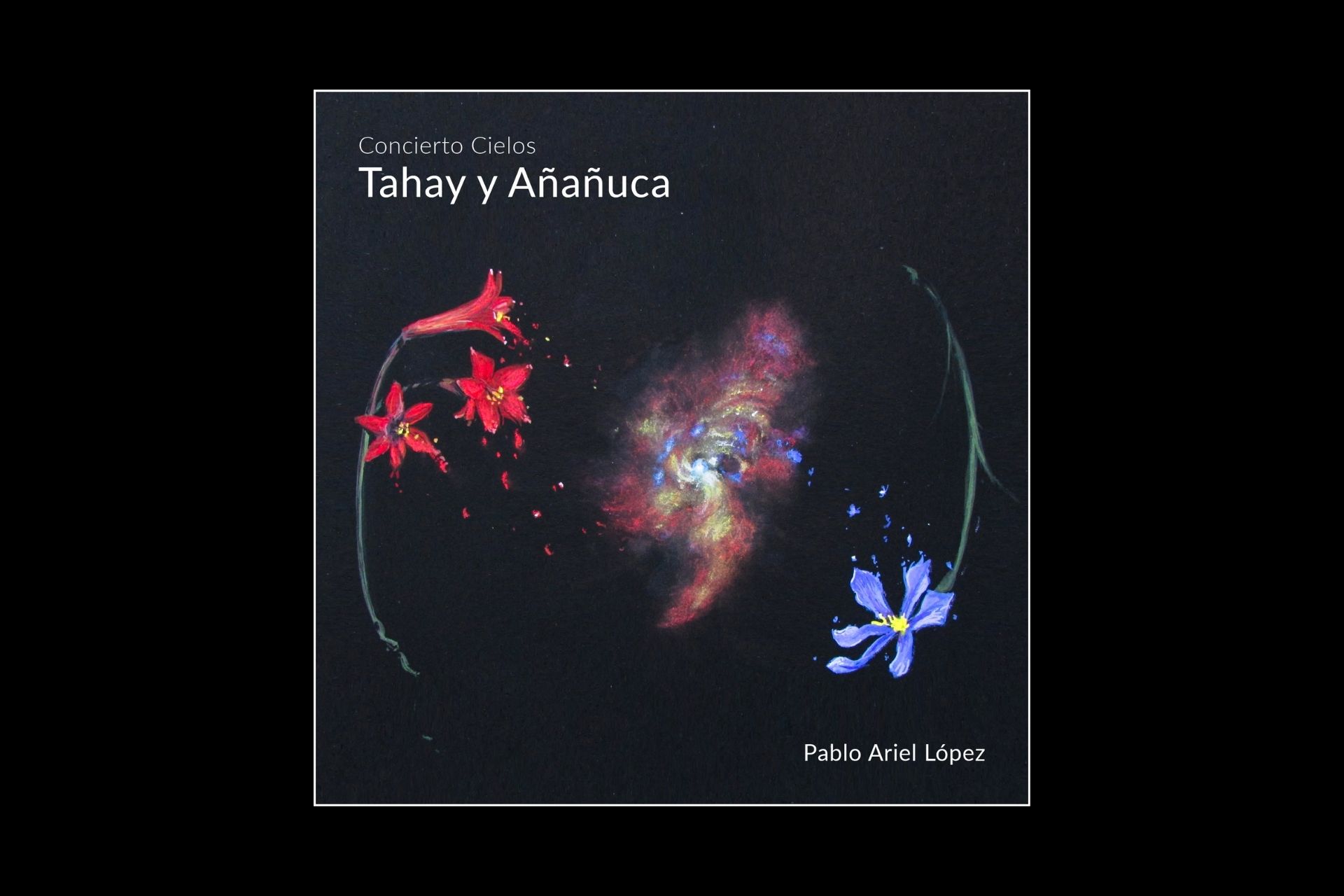
Concierto Cielos: Tahay y Añañuca is a musical journey inspired by the wonders of the universe and Chilean nature, woven around recent discoveries from Millennium Nucleus YEMS, with music by composer Pablo Ariel López and artistic direction by astrophysicist Sebastián Pérez.
Tahay and Añañuca are two endemic flowers of Chile, and also the names of the exoplanet GJ 367b and its star. Tahay, purple in colour, blooms for only a few hours each year, just like the short duration of a year on the exoplanet. Añañuca, bright red, reflects the brightness of its host star.
The second piece, Súper Saturno, imagines the exoplanet J1407b, a world with colossal rings, larger than those of any planet in the Solar System.
Next is V883 Ori, a star surrounded by a protoplanetary disc where water vapour has been detected — a key finding for understanding how water reached the planets.
The journey ends with V960 Mon, a young star where the possible formation of giant planets is observed in mysterious bluish clumps, visible both in the images and in the music. A recent discovery led from USACH and UDP.
The album artwork was created by illustrator Valentina Pérez Márquez, and connects stellar and exoplanetary formation with native flora represented by Tahay and Añañuca. This recording was made possible thanks to the support of Juan Escrig, Felipe Elorrieta, Andrés Zúñiga and Javier Farfán at Universidad de Santiago de Chile.
Album cover, illustrated by Valentina Pérez Márquez. The work connects stellar and planetary formation with Chilean endemic flora, symbolised by the Tahay and Añañuca flowers.
More about the origin of the names
"Tahay" (exoplanet) and "Añañuca" (host star), names inspired by endemic flowers of Chile, were put forward by the Millennium Nucleus on Young Exoplanets and their Moons (YEMS) and the Centre for Interdisciplinary Research in Astrophysics and Space Exploration (CIRAS), within the framework of the International Astronomical Union's NameExoWorlds competition.
The first exoplanets were discovered in the mid-1990s, and more than five thousand have been identified since then. In the NameExoWorlds 2022 edition, the IAU selected 20 new names for exoplanets and their host stars, as part of the celebrations of the tenth anniversary of its Office for Astronomical Outreach. These systems are of special interest, as they will be among the first exoplanets observed by the James Webb Space Telescope (JWST).
Both names were submitted to the competition by Millennium Nucleus YEMS, the CIRAS at USACH, in collaboration with the amateur astronomical observatory Astroquinta of Quillota.
"We are very happy that the names we sponsored were selected, especially because the process was participatory. We received more than seventy proposals associated with Chilean flora, fauna and volcanoes; from these we selected twenty for a popular vote, and finally the winners were the names proposed by Mariana Durán and Catalina Ramírez," said YEMS postdoctoral researcher Irma Fuentes.