The international conference Born in Fire: Eruptive Stars and Planet Formation brought together more than 100 scientists from the planet formation and eruptive stars communities during four days of dynamic discussions in Santiago, Chile. The event was characterized by healthy, constructive exchanges between researchers at different career stages, a touch of Chilean hospitality, and the birth of several new collaborations.
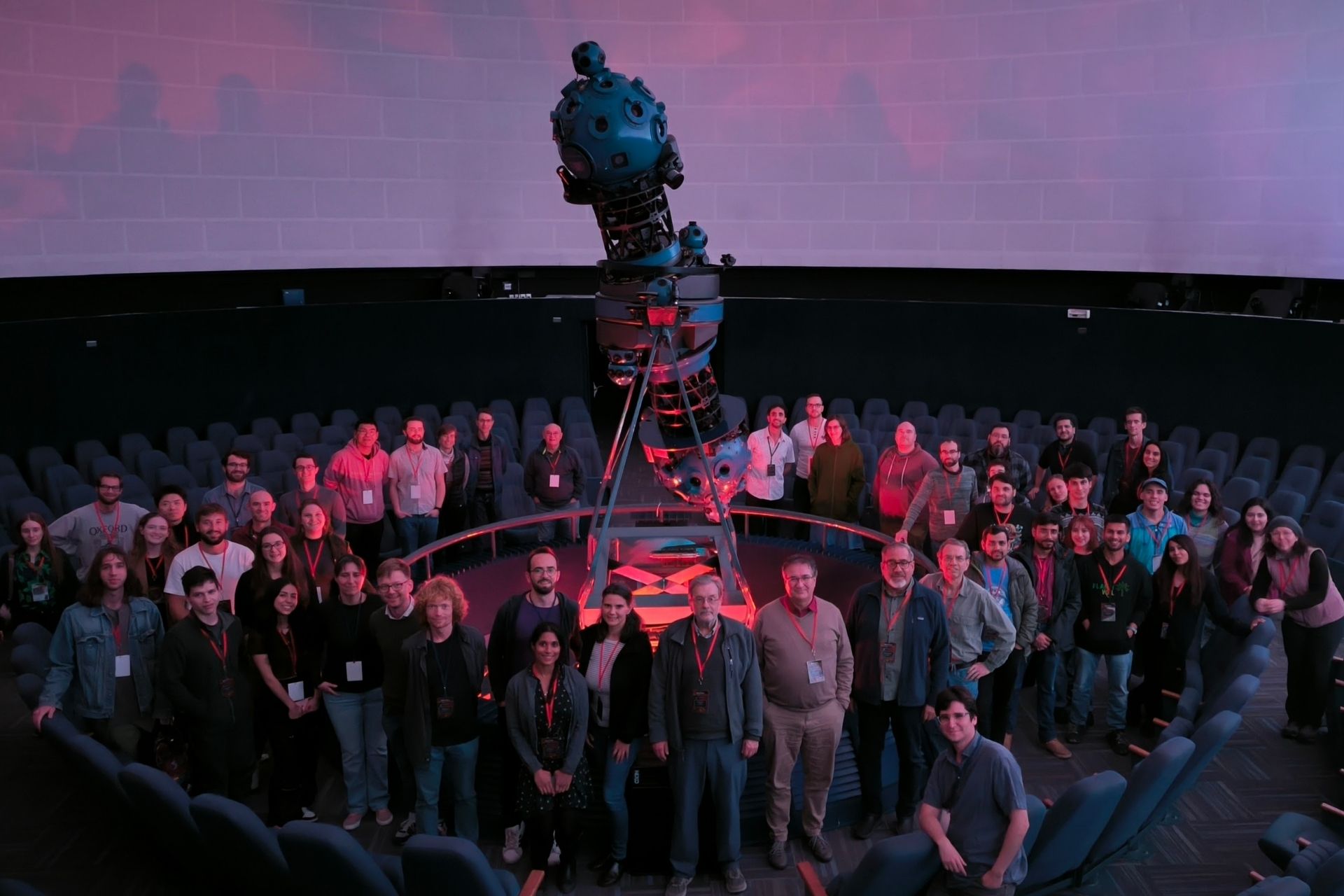
Conference attendees at the USACH Planetarium. Credit: S. Pérez.
Many attendees highlighted the smooth operation of the hybrid format by Universidad Diego Portales and the warm reception provided by Millennium Nucleus YEMS. With funding from NRAO through NAASC, registration fees were waived for more than 30 students and early-career researchers, enabling their participation and making the event more inclusive and enriching.
Born in Fire: Eruptive Stars and Planet Formation was organized by the Instituto de Estudios Astrofísicos UDP through Millennium Nucleus YEMS. The Biblioteca Nicanor Parra at Universidad Diego Portales served as the venue, with the conference running from Tuesday 24 to Friday 27 September, bringing together experts in eruptive stars, planet formation, and computational modelling.
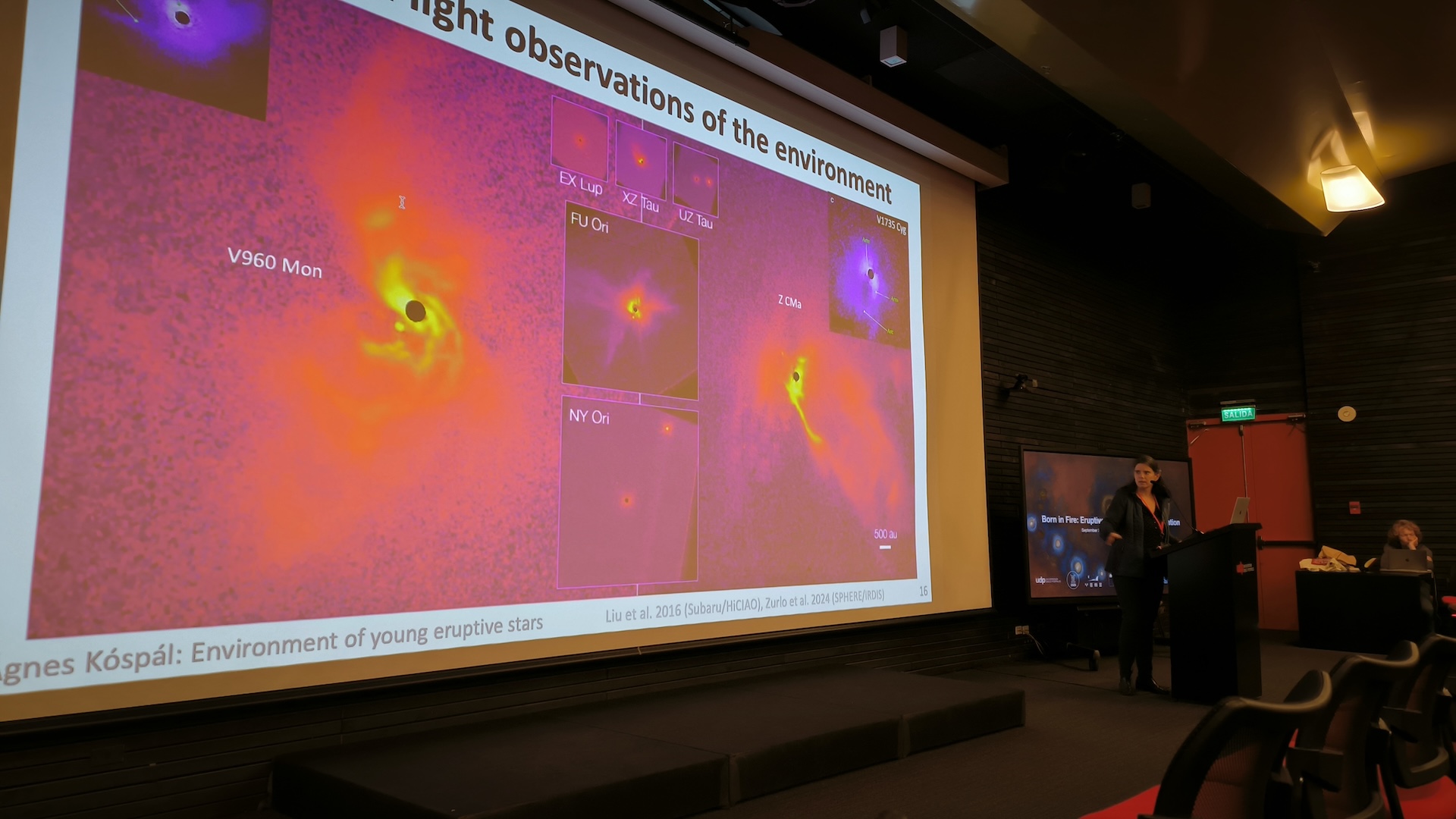
The event was coordinated by the Instituto de Estudios Astrofísicos of the Faculty of Engineering and Sciences at UDP, through Millennium Nucleus YEMS, together with USACH and NAASC – North American ALMA Science Center, with the support of the National Research and Development Agency (ANID) of the Ministry of Science, Technology, Knowledge and Innovation.
"The objective of this conference was to bring together scientists who work globally in the area of young eruptive stars. These objects, known as FU Ori stars, are fundamental for understanding how planets form, but due to their rarity (fewer than one hundred are known in the entire Galaxy) their study had been relatively limited," explained Lucas Cieza, researcher at the Instituto de Estudios Astrofísicos UDP and member of the Scientific Organizing Committee.
"It is believed that, rather than being a type of object, FU Ori stars represent an evolutionary stage of the majority of stars which, while very short in astronomical terms, profoundly affects the evolution of planetary systems," Cieza added.
The conference explored emerging paradigms: Is there a link between the irregular accretion patterns observed in some young stars and planet formation? Do the mechanisms driving episodic accretion in eruptive stars contain clues about the formation of giant planets? What do observations of eruptive stars tell us about gravitational instabilities near young stars? These questions guided the sessions, with the aim of connecting planet formation with the dynamic world of episodically accreting stars, and of facilitating collaborations between experts in eruptive stars, planetary formation, and computational modelling.
The Instituto de Estudios Astrofísicos at UDP, an international leader in observing FU Ori objects, had already made fundamental contributions in this area. For its part, Millennium Nucleus YEMS adopted the study of young eruptive stars as one of its main research lines. This international conference effectively established new collaborations and expanded the community dedicated to this field.
Event details
Title: Born in Fire: Eruptive Stars and Planet Formation
Website: https://fireborn2024.github.io
Dates: 24–27 September 2024
Venue: Biblioteca Nicanor Parra, Universidad Diego Portales, Santiago, Chile (with activities at USACH Planetarium)
Organisers: Instituto de Estudios Astrofísicos UDP and Millennium Nucleus YEMS, in collaboration with USACH and NAASC.
Support: ANID – Ministry of Science, Technology, Knowledge and Innovation.