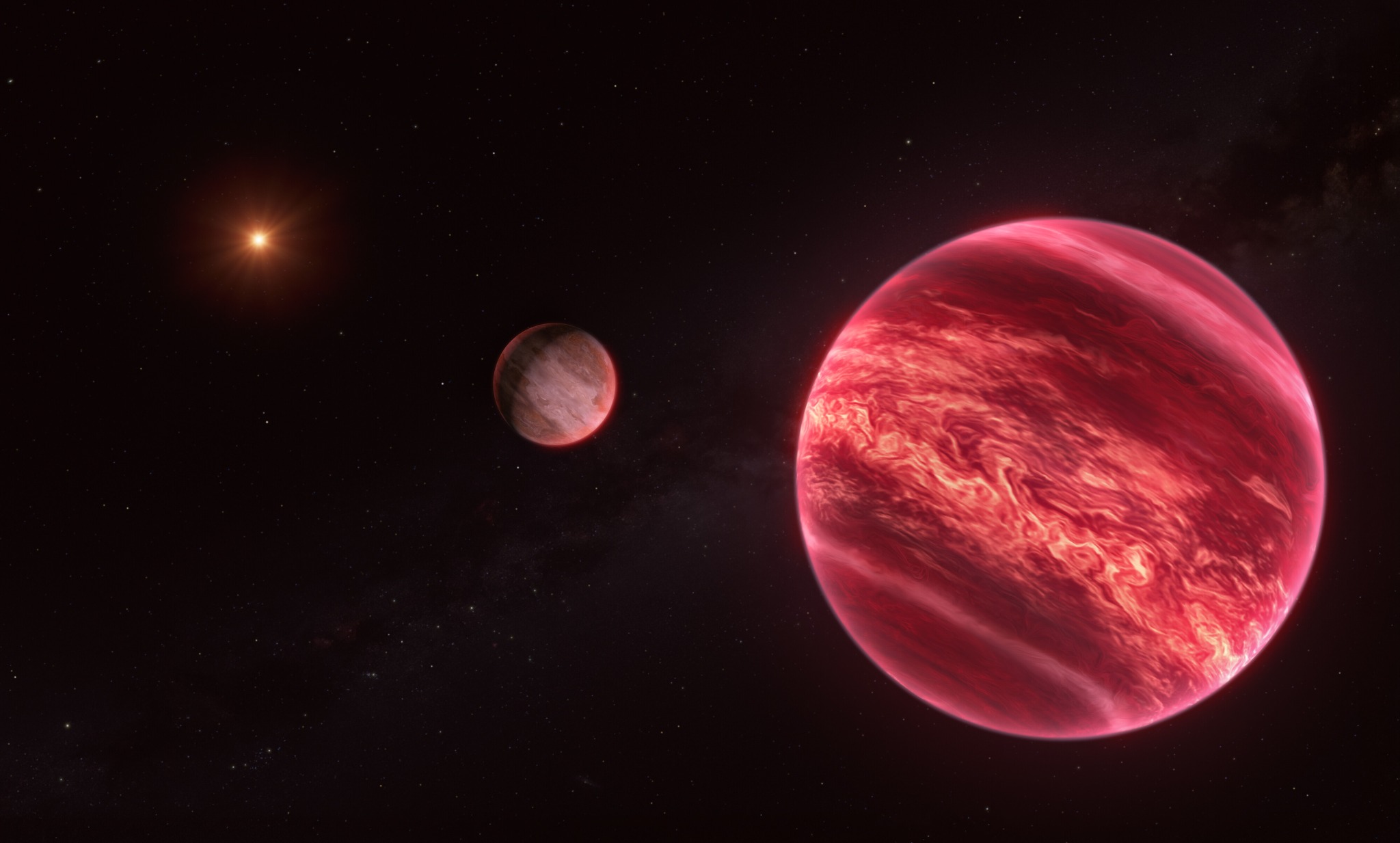
An international team led by researchers from the Millennium Nucleus YEMS reports in Nature strong evidence of a planetary-mass satellite orbiting CD-35 2722 B, a young brown dwarf that itself accompanies a star. The result opens a new path for finding moon systems beyond the Solar System and raises a fundamental question: when should a satellite be called an exomoon?
More than 6000 exoplanets have been discovered, yet no satellite around an extrasolar world has been convincingly confirmed. Several candidates have been proposed using other techniques, but they remain debated. The new study presents a periodic signal consistent with at least one object orbiting a directly imaged brown dwarf.
Artist’s impression of the CD-35 2722 system. The satellite candidate orbits a brown dwarf, which in turn orbits a star. Credit: ESO/M. Kornmesser.
A familiar technique in a new kind of system
The team used the radial-velocity method , the same strategy that led to the discovery of the first exoplanet around a Sun-like star. An orbiting object exerts a small gravitational pull on its host, producing a periodic motion that can be measured in the host’s spectrum. Here, rather than measuring a star, the researchers analysed the light of the brown dwarf CD-35 2722 B itself.
The observations were obtained with CRIRES+ , the high-resolution infrared spectrograph on ESO’s Very Large Telescope (VLT) at Paranal Observatory in Chile. The programme monitored the target from October 2023 to February 2026. After excluding low-quality observations, the analysis used 23 high-precision epochs.
CD-35 2722 B has a mass of about 37 Jupiters and lies far enough from its star for CRIRES+ to isolate its spectrum without significant contamination from the primary star. That geometry was essential for reaching a precision substantially better than previous radial-velocity searches for satellites around directly imaged planets or brown dwarfs.
A signal with a period of about 170 days
The measurements show a highly significant periodic variation. The favoured model includes a satellite candidate with a minimum mass of roughly 0.7 Jupiter masses and an orbital period of about 170 days . Because the orbital inclination is unknown, the true mass may be higher, although it is unlikely that the object is another brown dwarf.
The data can also be described by a second scenario with two satellites: an outer body with a period near 170 days and an inner body near 87 days, close to a 2:1 orbital resonance. However, dynamical simulations with REBOUND show that most two-satellite configurations would be unstable unless they occupy a very specific geometry. The team therefore considers a single satellite on a moderately eccentric orbit the more likely explanation.
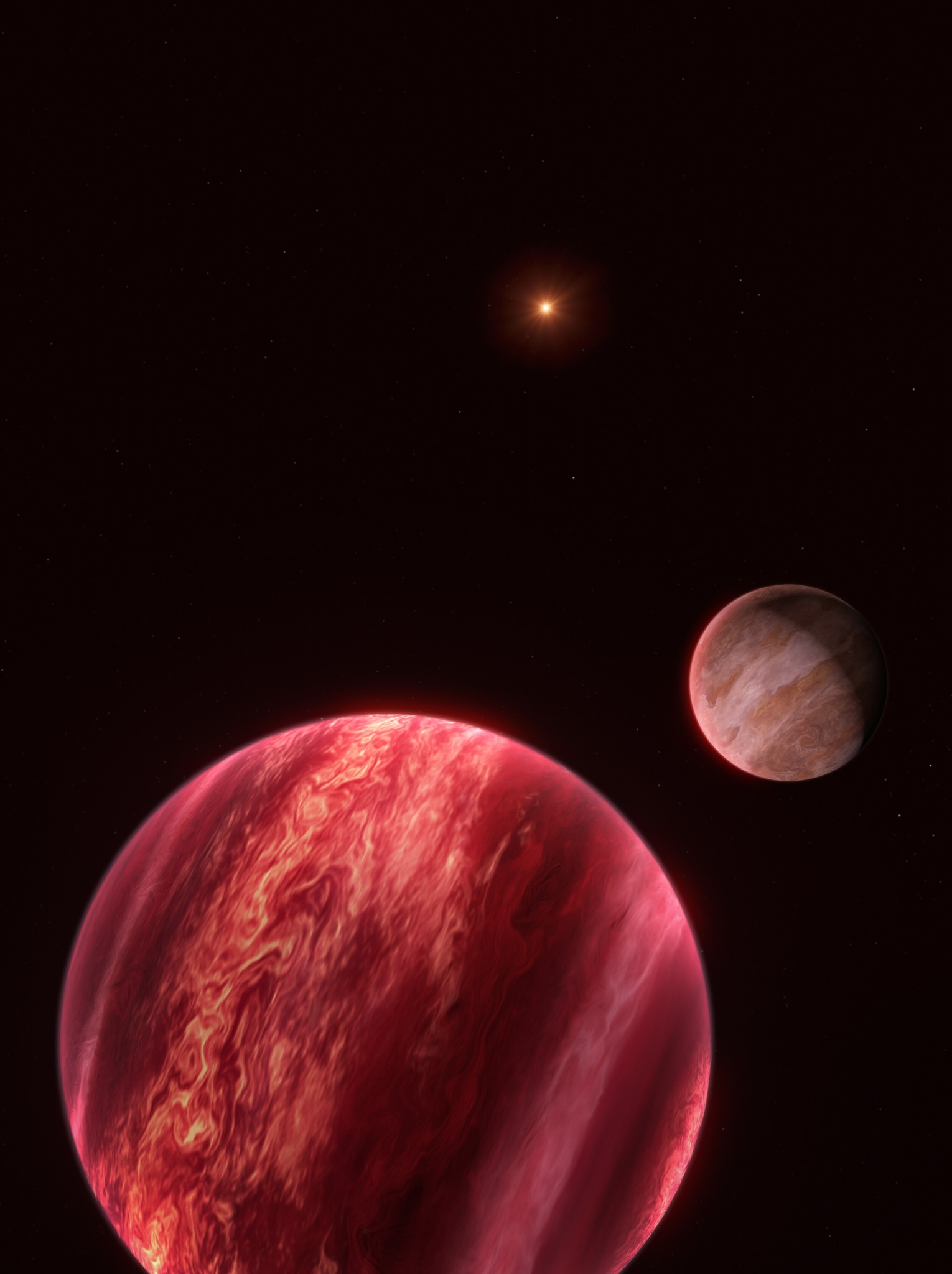
The system would contain three hierarchical levels: a star, a brown-dwarf companion and a planetary-mass satellite. Credit: ESO/M. Kornmesser.
Satellite, planet or exomoon?
Classifying the object is not straightforward. The candidate orbits a brown dwarf rather than a planet, and it is far more massive than the moons of the Solar System. At the same time, it occupies the final level of a three-tier hierarchical system and is small compared with its host, both moon-like properties.
There is currently no internationally accepted definition of an exomoon . The study therefore uses the neutral term satellite . The discovery highlights how categories developed to describe the Solar System may be insufficient for the diversity of architectures found around other stars.
A new window on how worlds form
Satellites preserve information about the formation and dynamical evolution of their systems. A future population of similar objects will allow researchers to test models of satellite formation around planets and brown dwarfs, investigate orbital resonances and migration, and study hierarchical systems that until now have largely been theoretical.
Although the CD-35 2722 B candidate is too massive to resemble a potentially habitable moon, detecting extrasolar satellites also matters for the search for life. In other systems, tidal heating could keep moons active and potentially habitable even beyond the classical stellar habitable zone.
Future observations will be decisive. Longer monitoring can test whether the signal persists, refine the orbit and distinguish more clearly between the one- and two-satellite scenarios. If confirmed, this would be the first observed system in which a satellite orbits a substellar object that itself orbits a star.
Research led from Chile
The study was led by Kevin Hoy , a PhD student at Universidad Diego Portales and a member of YEMS, together with Alice Zurlo , Director of the Millennium Nucleus YEMS. The team also includes Pablo A. Peña R., Jana Köhler, Silvano Desidera, Raffaele Gratton, Cecilia Lazzoni, Simon Petrus, Florian Rodler, Jonathan Smoker, Valentina D’Orazi, Ilaria Carleo and Ilaria Giovannini.
The collaboration brings together researchers from Universidad Diego Portales, ESO, YEMS, CATA, TLS Tautenburg, NASA Goddard, INAF Padova, INAF Rome, the University of Rome Tor Vergata and the University of Padova. The study combines observations obtained from Chile, high-precision spectroscopy, orbital modelling and dynamical simulations.
For YEMS, this result addresses one of the central questions that motivated the centre: moving from the study of young exoplanets toward the detection and characterisation of their satellite systems.
Contacts
YEMS Communications
Millennium Nucleus YEMS
comunicacionesyems@gmail.com
Kevin Hoy
Institute of Astrophysical Studies, Universidad Diego Portales; European Southern Observatory (ESO); Millennium Nucleus YEMS
kevin.hoy@mail.udp.cl
Alice Zurlo
Institute of Astrophysical Studies, Universidad Diego Portales; Director of the Millennium Nucleus YEMS
alice.zurlo@mail.udp.cl
Source: ESO press release eso2610 .