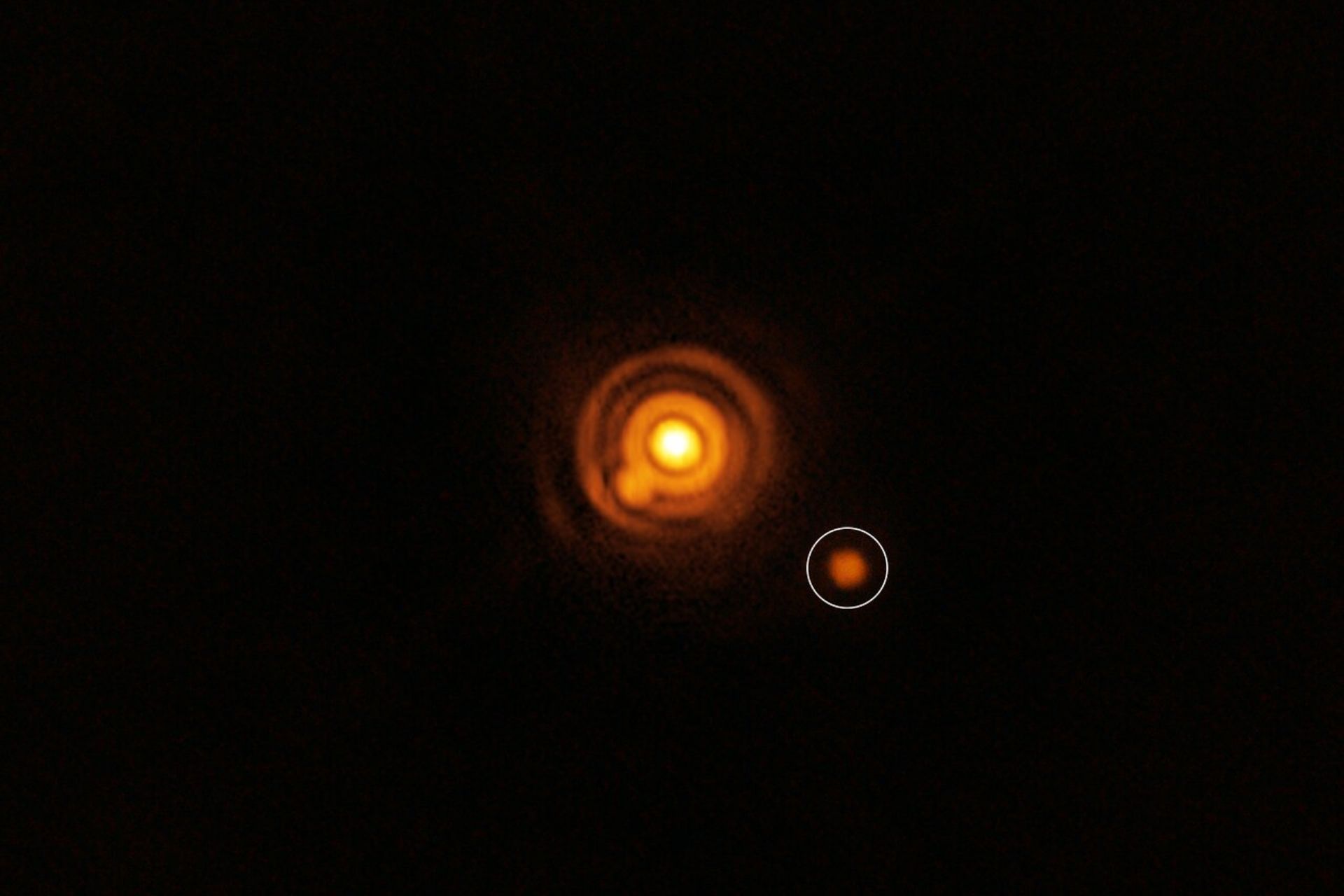
A team of astronomers at Millennium Nucleus YEMS has recently used the ERIS instrument at ESO's Very Large Telescope (VLT) to observe a young star called V960 Mon, still in the early stages of its life. In a study published on 18 July in The Astrophysical Journal Letters, the team reports the discovery of a companion object to this star, whose exact nature still remains a mystery.
The new study, led by YEMS PhD student and researcher Anuroop Dasgupta, followed up on earlier observations of V960 Mon made a couple of years ago. Those observations, obtained with SPHERE and the Atacama Large Millimeter/submillimeter Array (ALMA), had revealed that the material orbiting the star is organised into a series of complex spiral arms. They also showed that this material is fragmenting in a process known as gravitational instability, in which large clumps of gas and dust collapse upon themselves, with the potential to form planets or more massive objects.
"That work revealed unstable material, but left open the question of what happens next. With ERIS, our goal was to look for compact, luminous fragments that would signal the presence of a companion in the disc — and we found it," says Dasgupta.
The team detected a possible companion object very close to one of the spiral arms previously observed with SPHERE and ALMA. According to the researchers, this object could be a forming planet or a brown dwarf — an object more massive than a planet but that could not accumulate enough mass to shine as a star.
"It is important to emphasise that this is a high-impact piece of work led by a student at a Chilean institution," stresses Sebastián Pérez, astronomer at USACH and YEMS deputy director and co-author. "Regardless of the outcome of this formation process, the most interesting thing is that this is the first time we can witness this process. If confirmed, this object would be the first direct detection of a planet or brown dwarf forming through gravitational instability," says UDP astronomer and YEMS Director Alice Zurlo, also a co-author.
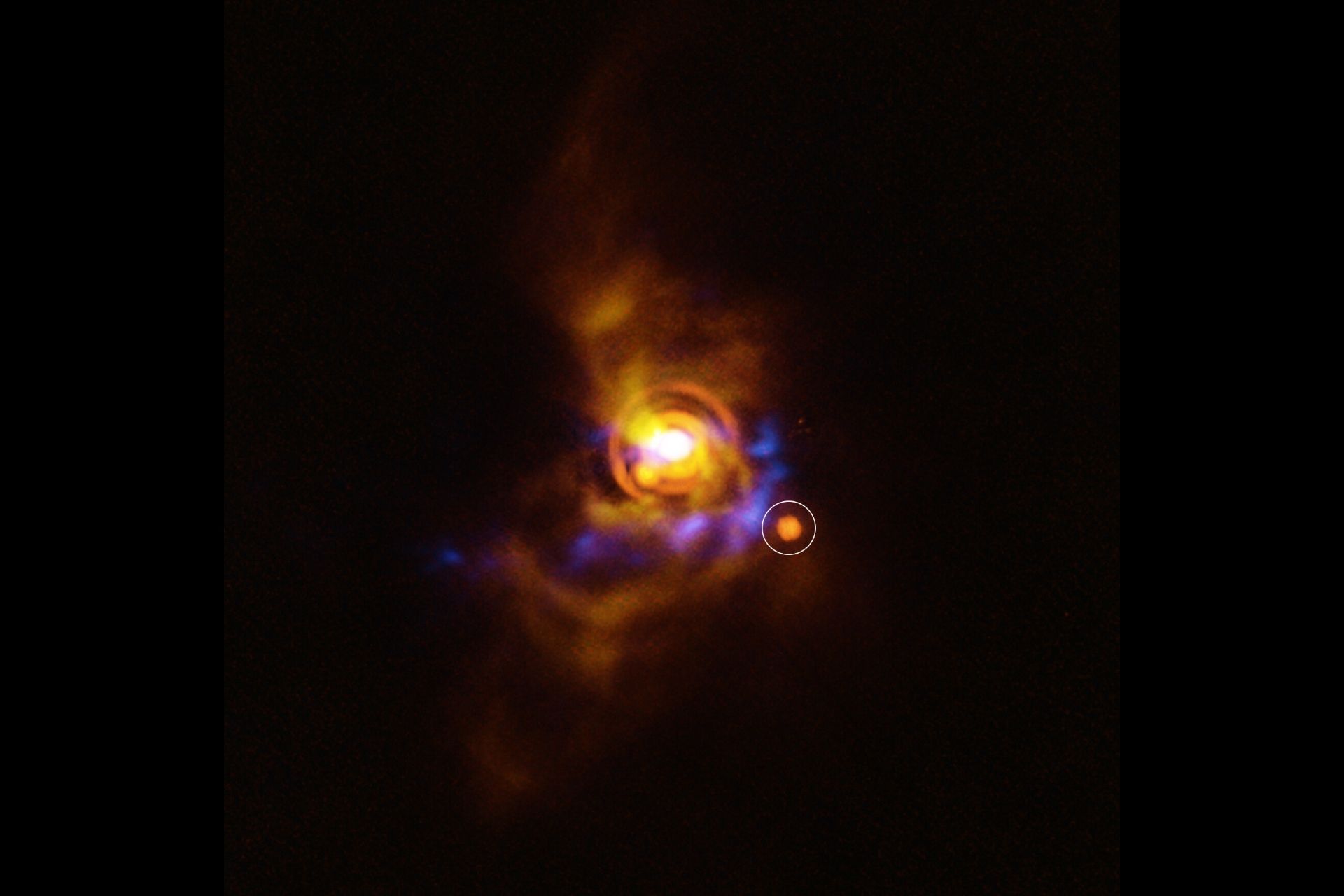
About the image
This image shows a possible companion object orbiting the young star V960 Mon. The star, located more than 5,000 light-years away, is surrounded by a disc with intricate structures. Previous analyses revealed the presence of clumps of unstable material that could collapse and form a companion object. The newly detected candidate could be a planet or a brown dwarf.
The candidate object was detected with ESO's VLT using its new ERIS instrument (Enhanced Resolution Imager and Spectrograph). The new ERIS data are shown in orange, overlaid on earlier images of the dusty disc obtained with the VLT's SPHERE instrument (yellow) and with ALMA (blue).
Credit: ESO/A. Dasgupta/ALMA (ESO/NAOJ/NRAO)/Weber et al.
The research team
The team consists mainly of members of the Millennium Nucleus on Young Exoplanets and their Moons (YEMS): A. Dasgupta (ESO, Santiago; UDP; YEMS), A. Zurlo (UDP; YEMS), P. Weber (USACH; YEMS; CIRAS), F. Maio (OAA; University of Florence), L. A. Cieza (UDP; YEMS), D. Fedele (OAA), A. Garufi (INAF Bologna; MPA), J. Miley (USACH; YEMS; CIRAS), P. Pathak (IIT Kanpur), S. Pérez (USACH; YEMS; CIRAS), and V. Roccatagliata (University of Bologna; OAA).
ESO press release:
"Astronomers Capture the Birth of a Planet Through Gravitational Instability"