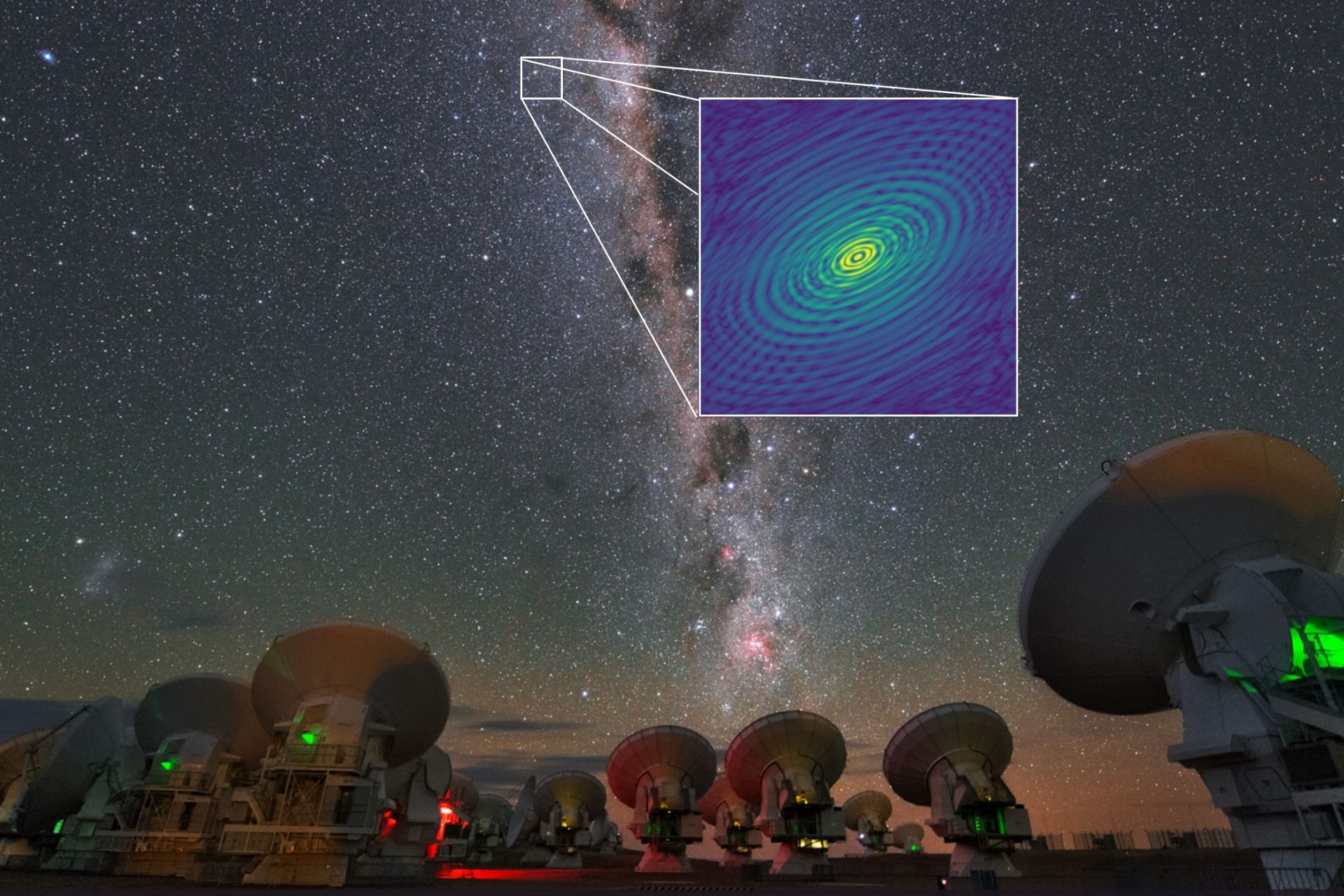
Radio telescopes in northern Chile.
By: Irma Fernández · 19 August 2024
A new interdisciplinary project between the Massachusetts Institute of Technology (MIT) and the Universidad de Santiago de Chile (USACH) has been awarded the MIT Global Seed Fund. The project, titled "AI Applications for Understanding Planet Formation Dynamics", aims to advance the analysis of astronomical data using artificial intelligence techniques.
The newly awarded MIT Global Seed Fund will enable collaboration between the group of Professor Richard Teague from the Planet Formation Lab in the Department of Earth, Atmospheric and Planetary Sciences at MIT and the Millennium Nucleus on Young Exoplanets and their Moons (YEMS) at USACH, led by Professors Sebastián Pérez and Fernando Rannou. This fund, amounting to approximately USD 20,000, will facilitate academic and student mobility, complementing interdisciplinary efforts in thesis projects at USACH's CIRAS Centre.
The project focuses on using artificial intelligence to improve the reconstruction and processing of images of protoplanetary discs observed by the ALMA Observatory. These discs, considered the birthplaces of planets, produce complex datasets that require advanced techniques for analysis.
The collaboration between Dr Teague and Dr Pérez began in October 2023, when they identified common interests in the dynamics of protoplanetary discs and their importance for understanding planetary formation. This project aims to leverage the complementary strengths of both researchers: Dr Teague in complex algorithms for data analysis and Dr Pérez in hydrodynamic modelling of planet-disc interactions.
"This project is a significant step towards the integration of artificial intelligence in astrophysics," commented Sebastián Pérez. "The combination of our skills and collaboration with computer engineers will enable advances in the analysis of complex data in a more efficient and precise way."
The project will involve several students from both institutions, who will focus on the development of AI algorithms for data analysis and will have the opportunity to participate in academic exchanges. Several publications in high-impact journals and the development of open-source software for the scientific community are anticipated.
For more information on previous projects funded by the MIT Global Seed Fund, visit MIT Global Seed Fund Winners.
Original source:
Universidad de Santiago de Chile (USACH)